
.png)
Purchase
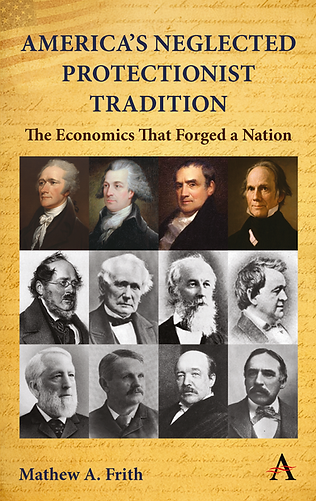
American's Neglected Protectionist Tradition has now been released! Secure yourself a copy by ordering today!
At a moment when protectionist trade policy has returned to the centre of global economic debate, America's Neglected Protectionist Tradition recovers the deep intellectual roots of that impulse — roots that stretch back to America's founding and that represent a far more sophisticated economic tradition than is commonly understood. This work offers the definitive treatment of the American protectionist school of economic thought — an intellectual tradition originating with the ideas of Alexander Hamilton and Tench Coxe, and developed further by thinkers such as Friedrich List, John Rae, and Henry Charles Carey. By drawing on the writings of nearly seventy economists and statesmen, this account provides the first systematic treatment of the philosophy and theory of the American protectionist tradition.
In reconstructing their system of thought, America’s Neglected Protectionist Tradition demonstrates that the American protectionists represented a coherent and systematic school of economic thought, and one that rivalled their English classical counterparts. Against the conventional literature on the topic, which treats American Protectionist thought as merely an adaptation of English classical economics, this work demonstrates that the American Protectionists developed a distinctive approach to economics. Not only did they differ from the Classicals on the policy recommendations concerning international trade, they rejected basic assumptions of the English classicals which remain foundational to contemporary economic analysis.
Central to the thinking of the American protectionist tradition is the idea of the economy as dynamic and inventive. Rather than seeing scarce resources as placing fixed limits on economic progress, the American protectionists looked to invention, human ingenuity, and the diversity of talents and aptitudes as the means of forging the wealth of nations. Among other areas of economic analysis, this work explores the American protectionists’ support for economic diversification, which stands in contrast with free trade theory’s emphasis on specialisation. By challenging the Classical view that individuals represent homogeneous and uniform factors of production, the protectionists saw mankind as possessing unique talents, aptitudes and dispositions. Protected diversification was thus necessary to allow individuals to exercise these unique qualities. By recovering this neglected tradition, this work not only fills a significant gap in the history of economic thought but also provides valuable historical perspective on contemporary debates regarding trade and industrial policy, technological innovation and economic development.
For more information, please visit: www.americanprotectionists.org